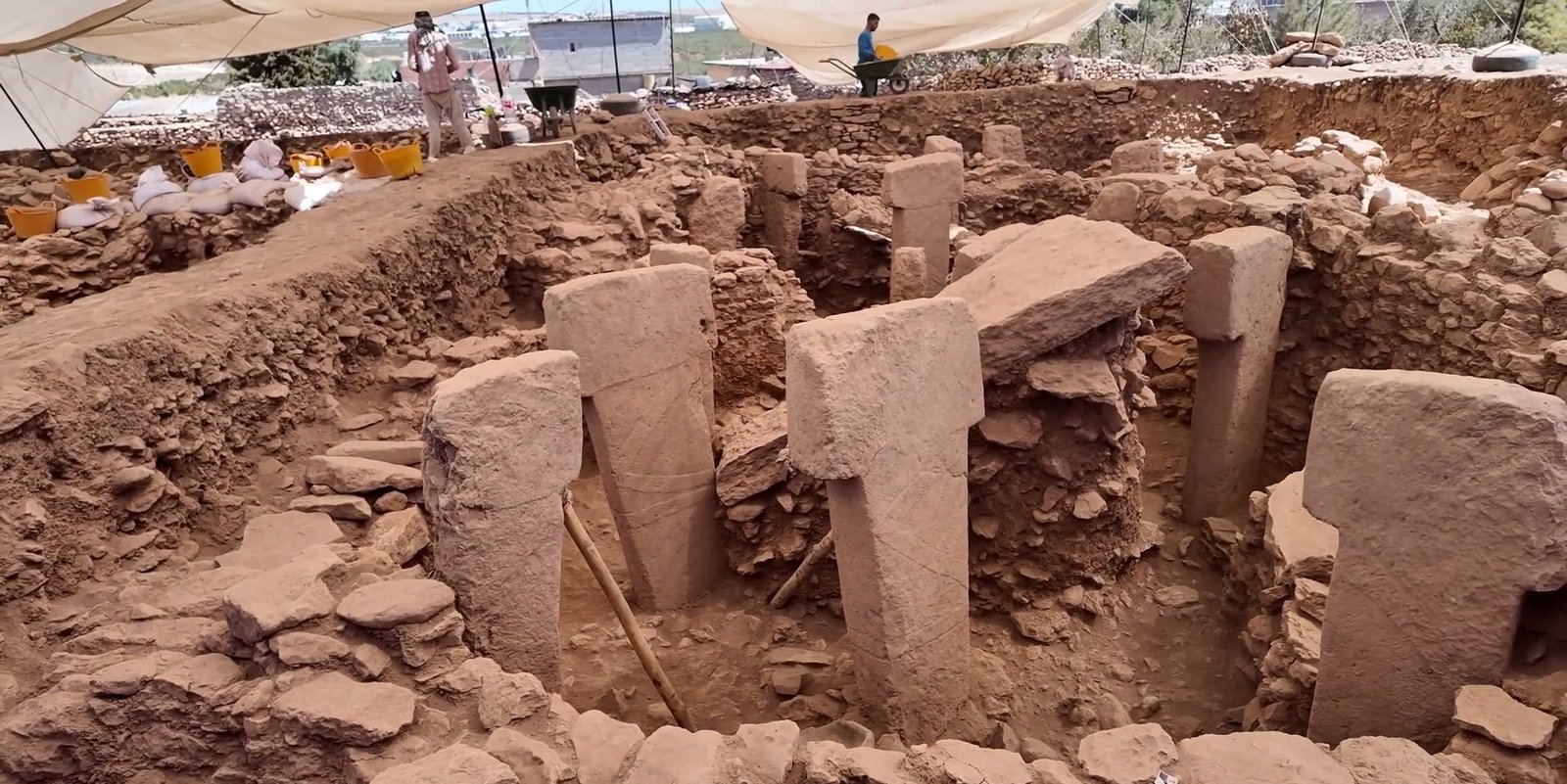
The T-shaped pillar is the signature of the Stone Hills. Seen head-on it is an abstract letter T; seen as its makers intended, it is a body — the horizontal top a head, the shaft a torso, with arms bending down the sides and hands meeting at the front, often above a carved belt. Sayburç has these pillars in its communal buildings and, strikingly, inside its houses.
A pillar the size of Göbekli's
One of the site's great stones is a large belted T-pillar — close in scale to the monumental pillars of Göbekli Tepe. Down its front runs a carved belt, the same "clothed" convention seen on the region's anthropomorphic pillars. To stand before it is to sense that these were never plain supports: they were presences.
Most of the pillars in that area have arms and belts, and sometimes a pelt in front. This one has a design I haven't seen at any of the other sites.
— field observation at Sayburç, on a squiggle-like motif carved on the pillar.
The squiggle
What makes the Sayburç pillar unusual is a small carved squiggle — a motif that, by the excavators' and observers' account, has not turned up on the pillars of the other Taş Tepeler sites. In a tradition defined by repeated, shared symbols, a genuinely local sign is intriguing: a dialect within the common language. What it meant, we can't yet say.
Pillars as people
The belts, arms, hands — and, on related figures, the V-shaped necklace — all point the same way: these stones were treated as human-like. At Sayburç, where a pillar can stand in the middle of a house, that blurring of stone and person, of monument and home, is the whole character of the place.
Sources
- Field observations at the Sayburç excavation (the belted pillar and its squiggle motif, 2025–26 season).
- Özdoğan, E. 2022 — Sayburç structures & pillars. Antiquity
- Comparative T-pillar iconography, Göbekli Tepe & Karahan Tepe.