We tend to assume the story ran one way: people learned to farm, grew a surplus of grain, and eventually brewed beer with the leftovers. Evidence from the Stone Hills suggests it may have been the other way around — that big communal feasts, and the drink that fuelled them, came first, and the pressure to feed those gatherings helped drive the domestication of wild cereals.
The giant basins
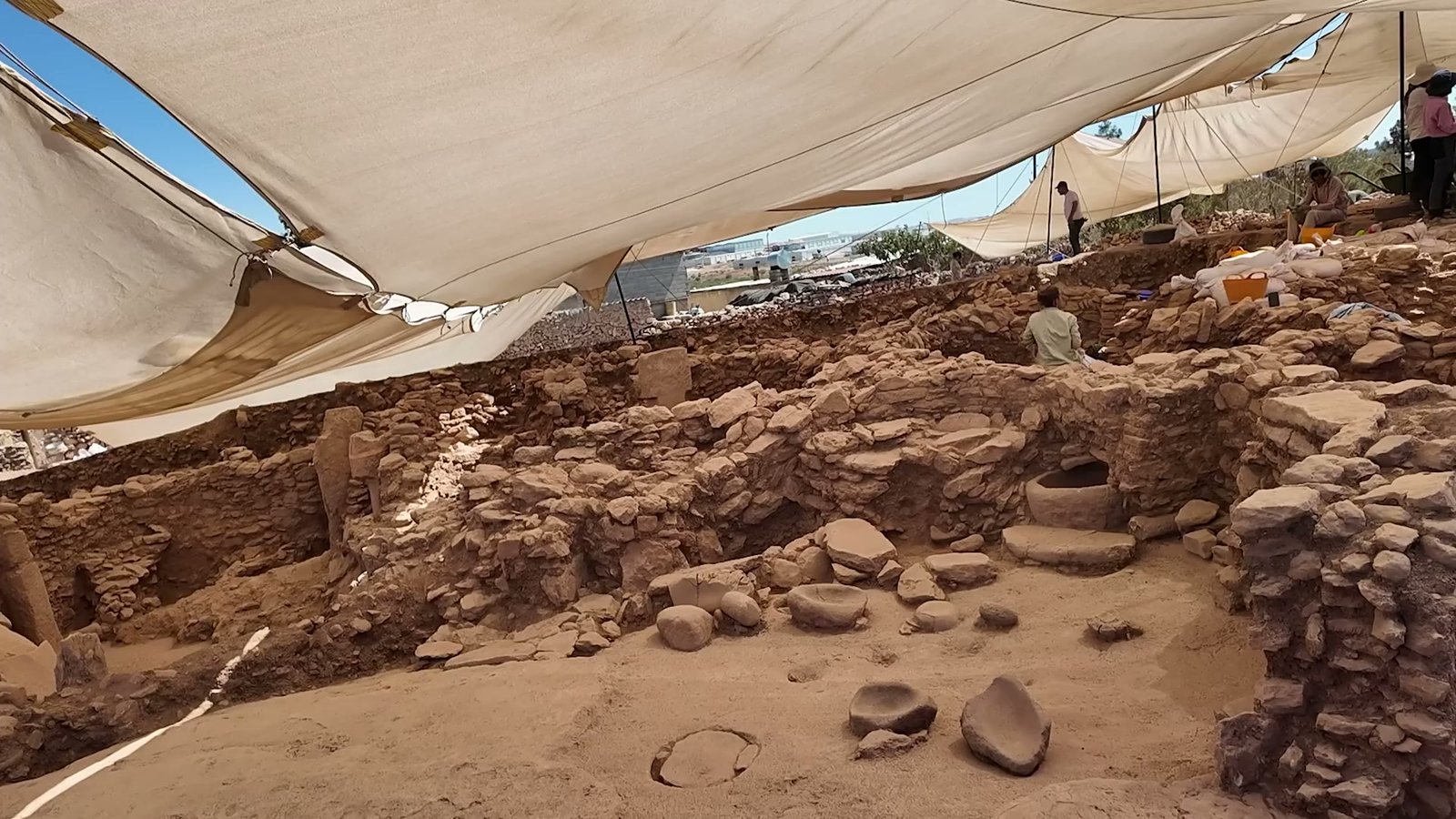
At Sayburç, excavation has exposed large stone basins and grinding equipment set into the buildings — the heavy machinery of processing grain at scale. Standing beside them at the dig, the team floated the obvious question about what they held: food, certainly, prepared with liquid — and, only half in jest, maybe beer.
Probably for food preparation — with liquids. Beer making? Why not.
— the excavation team, on the great stone basins, during filming at the site.
What's actually proven — at Göbekli Tepe
The hard evidence for early brewing comes from nearby Göbekli Tepe. There, researchers analysed six large limestone vessels — some holding up to ~160 litres — and found chemical traces of oxalate, a residue produced when grain ferments into alcohol. Combined with enormous quantities of animal bone, it paints a picture of large-scale feasting: many people gathered, fed, and quite possibly drinking together.
Why it matters
If gathering to feast and drink was central to these communities before farming was established, then the social appetite for feasts may have been one of the engines of the Neolithic itself. Beer, in this view, isn't a by-product of civilization — it's part of the glue that helped bring people together long enough to build it. Whatever filled the Sayburç basins, they belong to a world where coming together mattered enormously.
Sources
- Dietrich, O. et al. "The role of cult and feasting in the emergence of Neolithic communities… Göbekli Tepe." Antiquity 86(333). Cambridge Core
- Live Science, "Ancient Beer Breweries Unearthed." link
- Field observations at the Sayburç excavation (basins & food-processing evidence, 2025–26 season).