The central figure of the Sayburç relief has become famous fast: a male shown in high relief, flanked by two leopards with open mouths. Headlines reach for a single explanation — a god, a hero, a shaman. This page lays out what is actually described, what is genuinely debated, and why the meaning is best kept open.
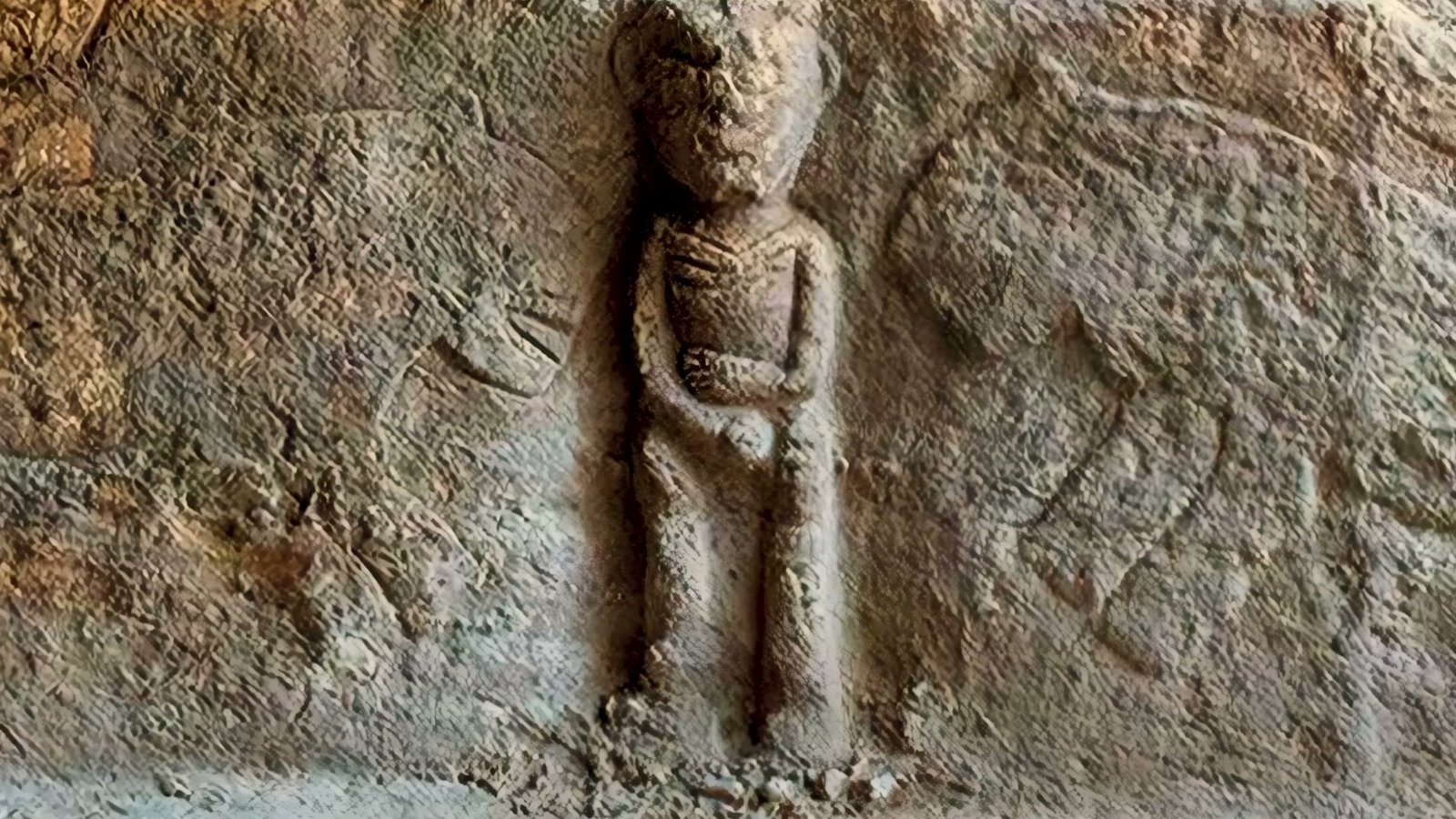
First, what is he holding?
You will see two versions online. In the peer-reviewed publication, excavator Eylem Özdoğan describes the man as holding his phallus in his right hand. Some early popular coverage guessed he was clutching a snake or a rattle. The published, first-hand description is the phallus — the "snake" reading was speculation layered on a low-resolution image. We follow the excavator.
The leopards: a shared predator
Leopards are not random. The big cat recurs across the Taş Tepeler world — carved on pillars and modeled as sculpture at Göbekli Tepe and Karahan Tepe, and even represented by real leopard bones at some sites. Placing a person between two of them frames the human against the most dangerous animal of the land. Whatever the story, the predator is doing symbolic work.
The leading interpretations
None of these is proven. Each is a lens:
1. Confrontation or danger
The simplest reading: humans facing beasts — leopards on one side, a powerful bull on the other. The scene dramatizes the encounter between people and the wild.
2. Initiation or rite of passage
In many later hunter-gatherer traditions, becoming an adult meant facing — or wearing — the apex predator. Some read the leopard-man as a moment of transformation, a person stepping across a threshold. It is an evocative parallel, not a documented fact about Sayburç.
3. Fertility, ancestry and continuity
The emphasized phallus, in a world before farming, may point to survival and future generations rather than to sex as such. The theme echoes the phallic imagery in Karahan Tepe's pillar room. Again: a resonance across sites, offered as a possibility.
Imagery must be read through its archaeological context. Isolated objects invite explanations the evidence cannot carry.
— the interpretive caution repeatedly stressed by the excavation team.
Why we keep the meaning open
Sayburç gives us something rare and real: a deliberate, composed scene, made to be seen by a gathered community. That is the finding. Turning it into one fixed myth adds nothing the stone can support and risks burying the actual discovery under a good story. The most accurate thing we can say is that these people were telling — and that they wanted an audience.
Common questions
Is he holding a snake or his phallus?
The published description by the excavator says a phallus, held in the right hand. "Snake" or "rattle" were early guesses from unclear images.
Is the leopard-man a shaman?
The shaman/initiation idea is a popular interpretation drawn from later cultures. It is plausible and widely discussed, but it is not established by the Sayburç evidence itself.
Does the scene depict a specific myth?
No known myth can be attached to it. Sayburç predates writing by thousands of years; we can see that it is a narrative, but not read its exact words.
Sources
- Özdoğan, E. 2022. "The Sayburç reliefs: a narrative scene from the Neolithic." Antiquity 96(390). Cambridge Core
- Arkeonews, "A relief of a man holding his phallus was found in Sayburç." link
- Science / AAAS, "Prehistoric carvings depict showdowns between humans and beasts." link